
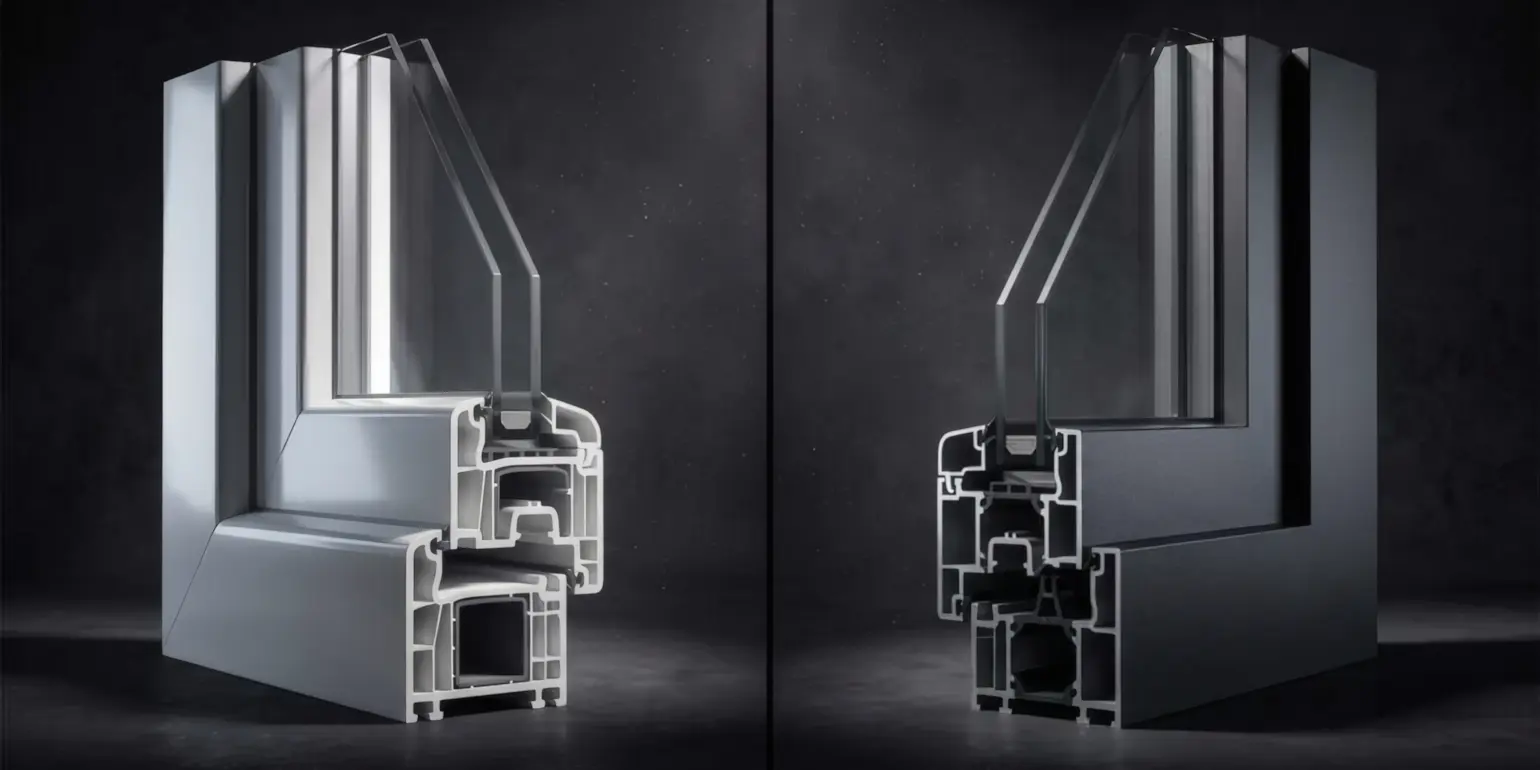
PVC or aluminium windows: it is the first decision when replacing the joinery in a home, and the one that shapes everything else, from the glazing you can fit to what you will pay for heating over the next thirty years. Both materials are good. Neither is «the best» in the abstract. One insulates better and costs less; the other allows bigger sashes and slimmer frames. The answer depends on where the house is, how large the openings are and what the rules for your façade say.
Here are the facts that genuinely separate the two, without repeating generalities: thermal transmittance, behaviour in sun and sea air, relative price, lifespan and the specific cases where each one makes sense. At the end there is a summary table and a quick guide by type of home.
Insulation: PVC wins here, and you see it on the bill
PVC is a poor conductor of heat. Aluminium is the opposite: it is one of the metals that transmits heat best. That is why an aluminium frame needs a so-called thermal break, a polyamide strip that separates the outer face of the profile from the inner one. Without it, the frame transmittance (Uf) is around 5.7 W/m²K, and in winter the aluminium is cold to the touch, with condensation and even frost on the inside. With a thermal break it drops to 2.5–3.5 W/m²K in ordinary profiles and to 1.8–2.2 in the best ones, with wide polyamides and foam inside the profile.
A 70 mm PVC profile with five chambers, such as VEKA 70, with nothing special about it, already starts at a Uf of around 1.3 W/m²K. An 82 mm one with seven chambers and a triple seal, such as VEKA 82, drops to 1.0–1.1. In other words: standard PVC insulates roughly twice as well as standard thermally broken aluminium, and for an aluminium frame to get close to a mid-range PVC you have to move up to the premium range, which you pay for.
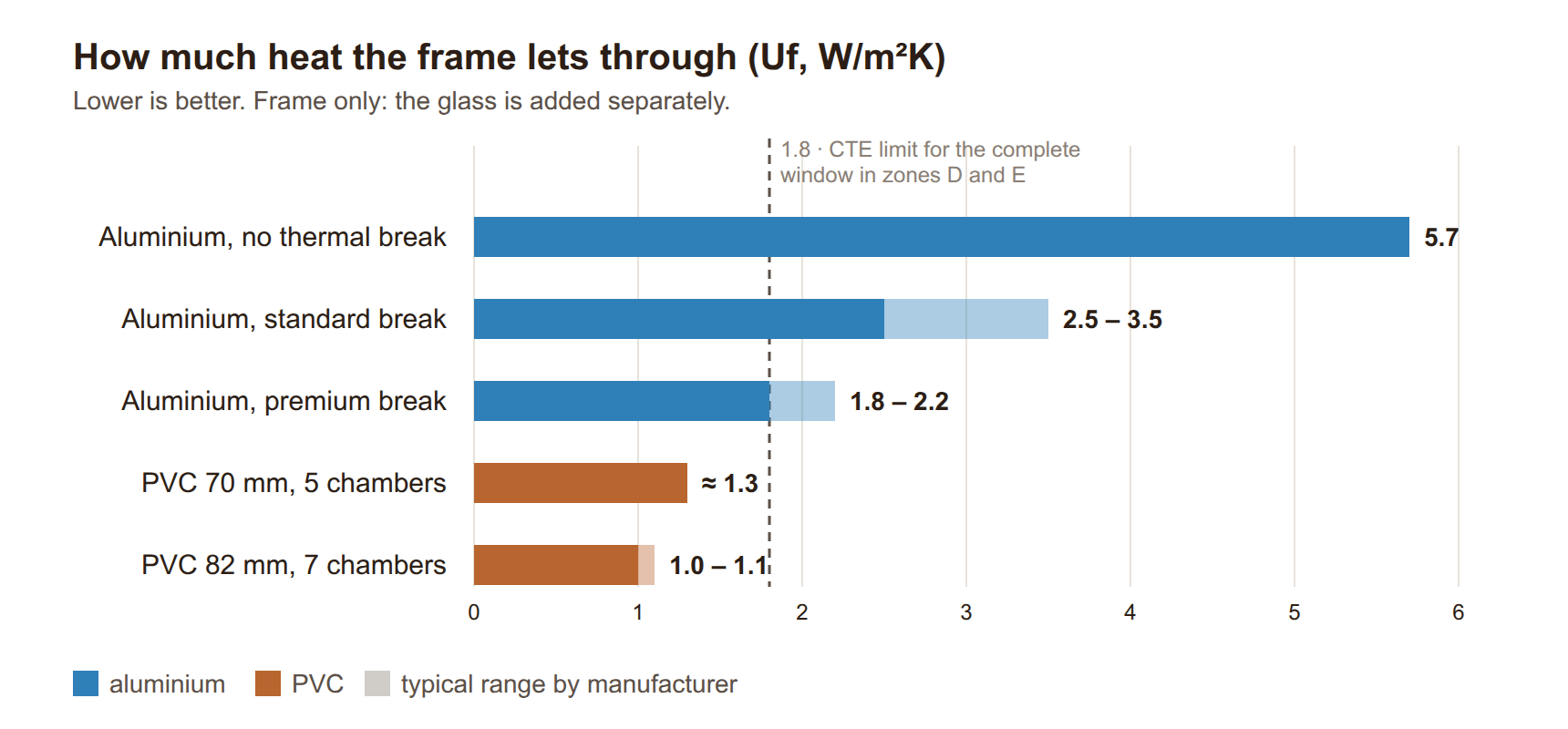
Frame Uf. The dashed line marks 1.8 W/m²K, the Spanish building code (CTE) limit for the complete window in climate zones D and E.
How much does this matter? It depends on the climate. In a flat in Alicante or Málaga with low-emissivity double glazing, the difference between a 1.3 frame and a 2.5 frame shows in condensation on winter mornings and in comfort next to the window, but it will not ruin anyone. In Madrid, Burgos or any climate zone D or E under the Spanish building code (CTE), where the complete window must stay below 1.8 W/m²K, ordinary aluminium forces you to compensate with very expensive glass, while PVC gets there effortlessly. Noise is similar: the glass decides, but with the same glazing PVC dampens a little better because the frame vibrates less.
Price, lifespan and what happens in the sun
With the same glass, hardware and size, a thermally broken aluminium window usually comes out 15 to 30 % more expensive than a PVC one. Aluminium without a thermal break is cheaper than both, but today there is no sense fitting it in a home: it does not meet the CTE requirements for new builds or renovations and you pay for it in heating every winter. Exact prices depend so much on the configuration that the best approach is to compare the same size in a configurator with the two glazing options you are considering.
In lifespan they are fairly even. A well-made powder-coated aluminium window passes 40 years; a European-profile PVC window with steel reinforcement, 30–40. In practice the first things to fail in either are the seals and the hardware, not the frame material, so that is where quality matters. Maintenance is minimal for both: water with neutral soap and a drop of oil on the handle mechanism once a year.
There are many myths about the sun. Modern white PVC contains UV stabilisers and titanium dioxide; it does not yellow or become brittle like the PVC of the eighties. What does happen is that PVC expands more than aluminium with heat, and an anthracite or matt black profile in full afternoon sun can exceed 70 °C on the surface. That is why dark colours are made with foils that reflect infrared, and why every serious profile has steel reinforcement inside: with that, the sash does not warp. If the façade faces south or west, with many hours of sun and large dark sashes, that is the case where you should ask for closed reinforcement or consider aluminium. On the coast, by contrast, PVC has the advantage: salt air does not affect it, while coated aluminium holds up well but can pit at edges and cuts if the coating is not marine grade.
When aluminium is the better choice
There are three clear cases. The first is size: when you want a floor-to-ceiling window with sashes over two and a half metres, or a sliding door with very wide sashes, the rigidity of aluminium allows slim profiles and glass almost edge to edge. PVC goes quite far (a PVC sliding window takes sashes of 1,600 × 2,300 mm), but beyond that the frame looks wider and heavier. The second is aesthetics: a slim-sightline aluminium profile, or a metallic anodised finish, has no equivalent in PVC. Today's coatings and foils imitate wood and greys very well, but not a real metallic finish.
The third is regulation, which is also the answer to the question of where PVC windows are «banned». No law bans them in Spain. What exist are municipal by-laws in historic centres, listed-building catalogues and the statutes of comunidades de propietarios (owners' associations) that fix the material, colour or appearance of façade joinery. Before ordering anything, ask the building administrator and, if the building has any protection, the ayuntamiento (town hall). It is a ten-minute check that saves having to take out brand-new windows.
Quick comparison
Criterion | PVC | Thermally broken aluminium |
|---|---|---|
Frame Uf (W/m²K) | 1.0–1.3 | 1.8–3.5 |
Sound insulation | Slightly better with the same glass | Good, depends on the glass |
Price for the same configuration | Lower | 15–30 % higher |
Very large sashes and slim profiles | Limited | Its strong point |
Coast and salt air | No corrosion | Needs a quality coating |
Strong sun on dark colours | Needs reflective foil and steel reinforcement | No problem |
Finishes | White, wood-effect foils and matt plain colours | Powder coatings, metallic anodised |
Indicative lifespan | 30–40 years | 40 years or more |
Maintenance | Minimal | Minimal |
Recycling | Recyclable, less energy to manufacture | Recyclable indefinitely, more energy to manufacture |
A note on the last row: a window's environmental footprint is decided above all by the energy it saves over 30 years, not by the energy it took to make. A window that insulates better more than makes up for the difference in manufacturing.
In short: what to choose for your home
For most homes in Spain the answer is PVC. A flat on the coast with normal openings: 70–72 mm with low-emissivity double glazing. A house inland or in a mountain area: 76–82 mm with 40 mm glazing or more and triple glazing in north-facing openings. It insulates better, does not suffer from salt air and costs less; aluminium only competes there in the premium range.
Aluminium wins when the opening is huge, when you want an almost invisible frame or a metallic finish, and when the by-law or the owners' association demands it. And nothing stops you combining: aluminium in the big living-room window, PVC in bedrooms and bathrooms.
If you go for PVC, at Cerraterm the VEKA, WDS and EKIPAZH systems range from 60 to 82 mm, with glazing from 24 to 52 mm; they are made to measure and delivered anywhere in mainland Spain in 15–30 working days with a three-year warranty. Configure the window with your measurements and compare two glazing options: it is the quickest way to see what really changes.