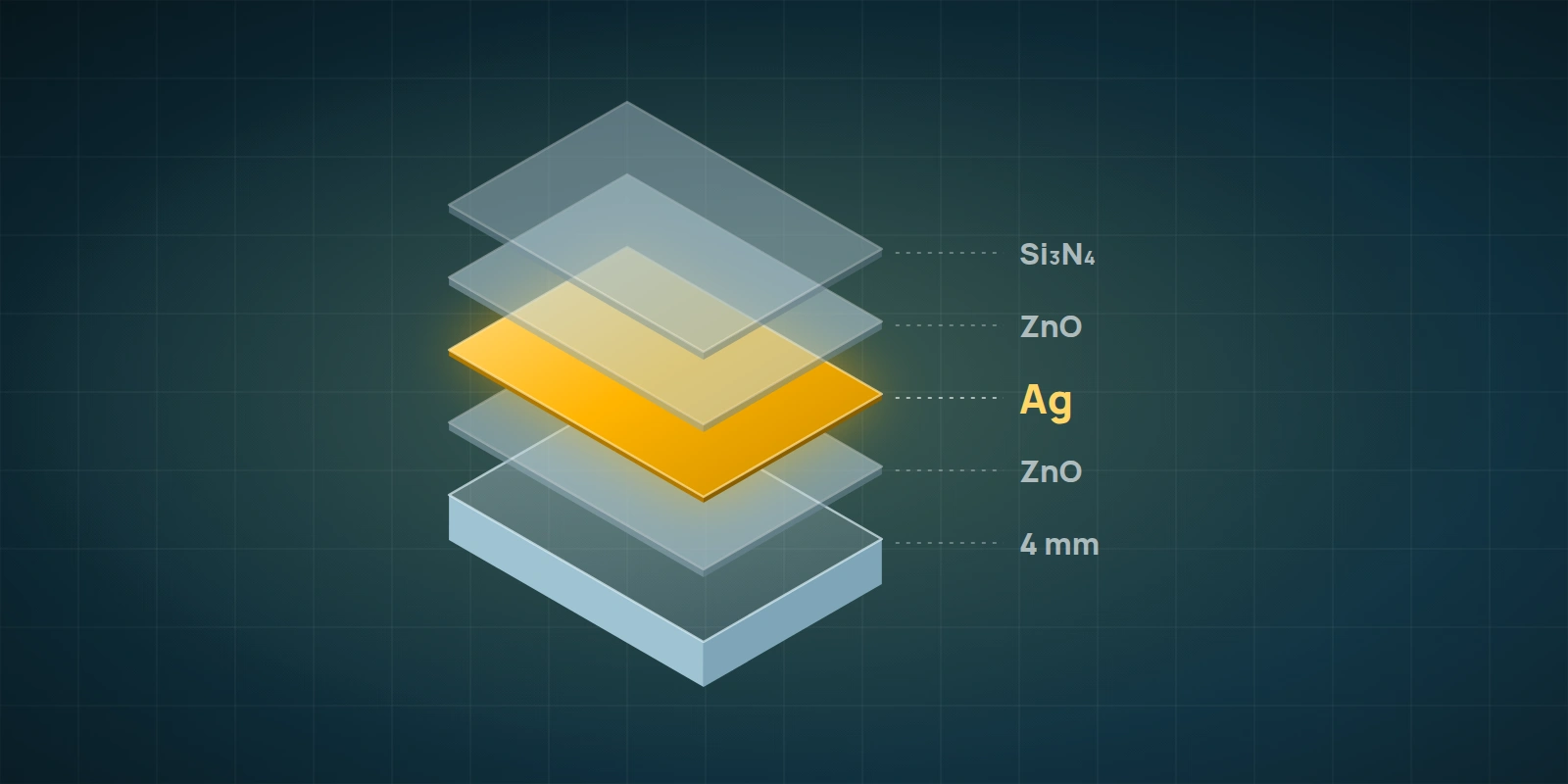
The coating alone takes 4-16-4 double glazing from 2.71 to 1.35, so it loses half as much heat. The comparison between the fourth row and the second is even more telling. Triple glazing without low-e, thicker, heavier and more expensive, insulates worse than double glazing with low-e. So when you compare windows, check first whether the glass has a coating, and only then how many cavities and millimetres it has.
Argon, a noble gas denser than air that is injected into the cavity, cuts the Ug of double glazing by another 17 %. Triple glazing with coatings on both outer panes and argon in both cavities reaches 0.6. Which option is enough in each zone is covered in our guide to Spain's CTE climate zones; without low-e, a window only complies on the warmest stretch of coast.
How to read the glass code and tell whether yours is low-e
The code describes the glass unit from the outside in, in millimetres. 4-16-4 means two 4 mm panes with a 16 mm cavity, 24 mm in total. 4/16/6 is the same with a 6 mm inner pane, which is stiffer for large sashes. A triple unit such as 4-14-4-14-4 has three panes and two cavities.
The letters add detail. An «i» after a pane means that pane has a low-e coating, and if it appears at both ends, as in 4i-14-4-14-4i, there are two coatings. «ar» in a cavity means argon. 3*3 is laminated safety glass, two 3 mm panes bonded with an interlayer that holds the pieces together if it breaks, and «sat» is satin (frosted) glass, the kind used in bathrooms. Shops also use trade names; in Spain «Climalit Plus», for example, is double glazing with a low-e pane.
There is a simple home test to see whether your current windows have it. With the room dark, hold a lighter flame close to the glass and look at the reflections. In double glazing you will see four, one for each surface. If they are all the same colour, there is no coating; if one has a different tint, reddish or purplish, that pane is low-e. Many manufacturers also print it on the spacer bar, the metal or plastic strip between the panes.
Low-e or solar control, and the drawbacks
The two types of glass do opposite jobs. Low-e keeps indoor heat in and lets most of the sunshine through, which helps warm the house in winter. Solar control glass reflects part of the solar radiation before it gets in, which you will appreciate on south- and west-facing walls in southern Spain. There are also glass types that combine both functions, called multifunctional glass.
Against the August sun a roller shutter lowered in mid-afternoon works better, because it stops the radiation before it reaches the glass. In areas with harsh summers, the most sensible choice is usually low-e glass for winter and a shutter for summer.
Low-e glass has three drawbacks. The coating takes away a little light and, from certain angles, gives the glass a slight sheen; once installed hardly anyone notices, although next to uncoated glass you can see the difference. Because it is metallic, it weakens radio signals slightly, and in a house with poor reception and every window like this your phone may lose a bar indoors. And on cold, clear mornings dew can form on the outside of the glass. This happens precisely because the heat from the house no longer reaches the outer pane, and on a clear night it cools down even below the air temperature.
Which glass to order for your windows
Low-e, always. For a new PVC window in Spain you won't find another upgrade that adds so much insulation for so little change. On the Mediterranean coast and in the south, 4-16-4i double glazing is enough, ideally with argon. On the central plateau and in the mountains it is worth moving up to triple glazing with two coatings and argon, in profiles such as VEKA 70 or higher.
In the configurator you choose the glass together with the profile and the measurements, and you see the price of each combination straight away. Before you confirm, check that the glass code includes the «i».